Executive leadership demands high performance.
But few leaders have the physical capacity necessary.
The Executive Resilience program is personalized 1:1 coaching for the leaders your organization depends on.
Using 5 years of data from my proprietary Resiliency Assessment developed in partnership with the University of Minnesota, I've measured resilience across 26 companies and multiple industries.
The data reveal a persistent problem:
leaders’ biological performance systems are underdeveloped relative to the demands of modern leadership.
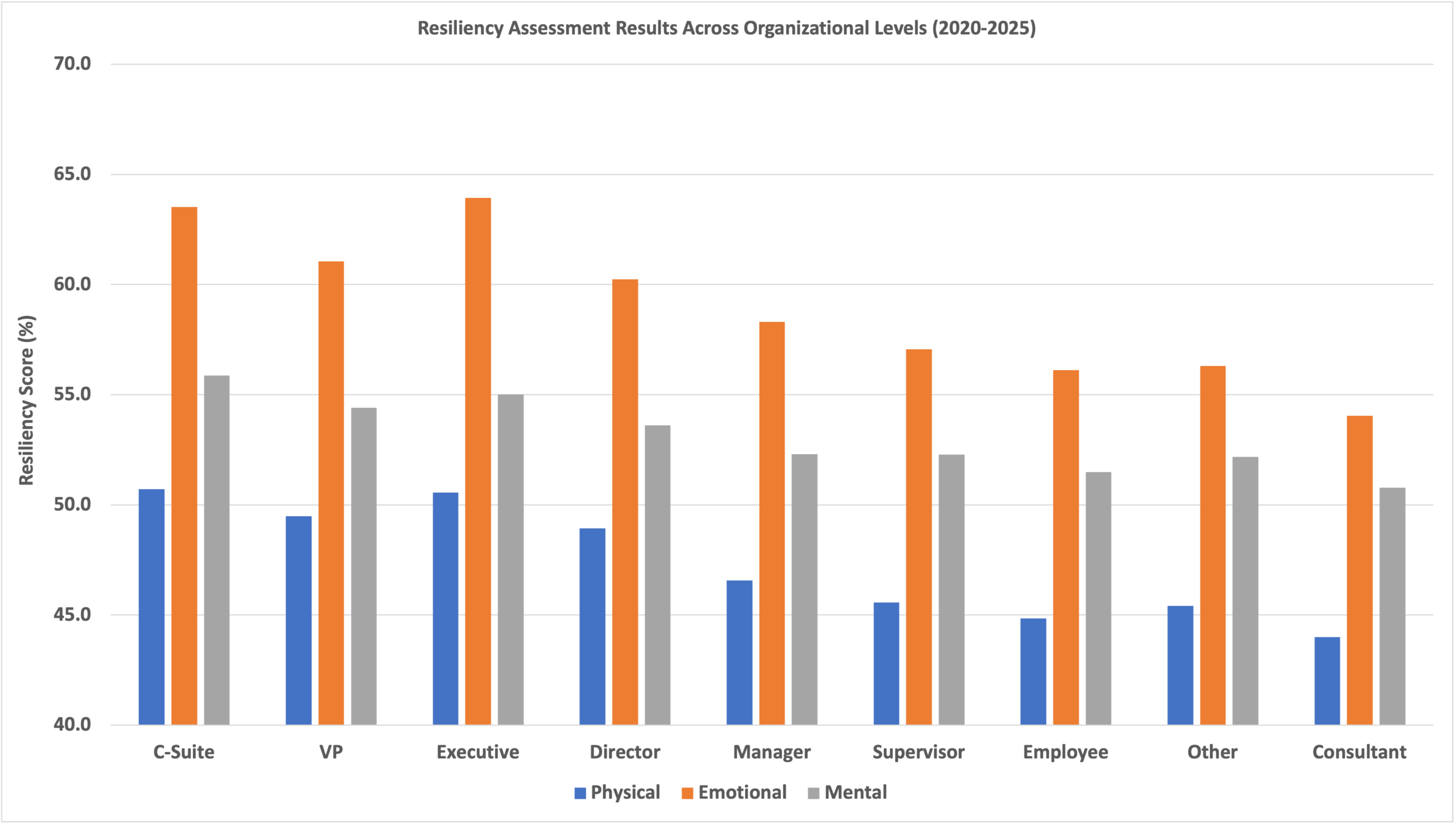
1. NO ORGANIZATIONAL LEVEL MEETS THE “RESILIENT” THRESHOLD
Across all roles, average resilience scores fall below 70%, the benchmark associated with sustainable performance. Even C-suite executives - who score highest at approximately 65% - remain below the benchmark for sustainable performance.
2. PHYSICAL RESILIENCE IS THE UNIVERSAL CONSTRAINT
Across every role, physical resilience scores 15-20 points below mental and emotional domains, averaging in the high 40s to low 50s.
Physical resilience determines a leader’s cognitive capacity, emotional regulation, stress tolerance, and decision quality.
When these biological systems are compromised, leadership performance becomes inconsistent regardless of experience or skill.
Performance is limited by biology, not mindset.

Why This Matters to Your Business
When your leaders operate in chronic stress without adequate physical resilience, that strain cascades down through every level, and your organization absorbs measurable costs:
Decision quality becomes unstable.
Stress impairs cognitive processing speed and increases inconsistency in decision-making.
Leaders makes different choices based on their nervous system state, not the data.
Execution speed slows.
Stress increases rework, indecision, and conflict, creating friction that delays execution.
Competitive advantage doesn't come from better strategy; it comes from faster, cleaner execution.
Organizational strain compounds.
Teams with high-stress leaders show higher burnout, reduced psychological safety, and increased turnover intent.
Leaders don't just set strategy, they set nervous systems.
The Performance Constraint Most Organizations Miss:
Chronic stress changes the chemistry of the brain and body. Elevated stress hormones like cortisol impair prefrontal cortex executive function - the brain region responsible for leadership, planning, judgment, and decision making.
Biology shifts cognitive resources to limbic threat processing, making your leaders emotional and reactive.
Put simply: you can't think your way out of a biology problem.
Depleted energy systems, poor recovery and sleep debt don't respond to positive thinking, they respond to physiological intervention.
Most organizations try to solve performance issues cognitively, but the real constraint is physiological - it’s the foundation on which mental and emotional resilience are built. They’re addressing the symptoms, not the source.

Cognitive performance improves
when leaders optimize sleep, recovery, and energy regulation. Better biology means faster processing, sharper memory, and more flexible thinking.
Emotional regulation strengthens
Physical resilience reduces cortisol-driven reactivity, allowing leaders to respond with clarity instead of urgency. Teams experience calmer, more stable leadership.


Decision quality stabilizes
When nervous systems are regulated, leaders make consistent decisions based on data, not their physiological state.
Execution speed increases
Reduced stress means less rework, fewer conflicts, and cleaner communication - decreasing execution drag.


Improved team stability
Regulated leaders reduce team burnout and turnover.
The Solution:
The Executive Resilience Program
A Comprehensive Approach to Unlocking Leadership Capacity
Your leaders are already working at maximum effort. But effort isn't the constraint - biological capacity is. The Executive Resilience Program targets the physiological foundation that determines decision quality, execution speed, and sustained performance.
This isn't a wellness initiative. It's a performance optimization system designed specifically for high-pressure leadership teams who need measurable results, not generic mindset training.
1. The Diagnostic
We start by running my proprietary Resilience Assessment with your leader. It's a comprehensive measurement tool that scores overall, physical, mental, and emotional resilience across multiple dimensions.
What they'll discover:
- Baseline resilience scores in overall resilience as well as physical, mental and emotional resilience
- Where the gaps are - where the leader is struggling and where they're depleted
- Variability patterns that signal operational risk and inconsistent performance
- Exactly what's constraining the leader's capacity right now
They'll walk away with a clear, data-driven picture of what's limiting leadership performance and where the highest-impact interventions are. No guessing. No assumptions. Just measured reality.
2. Personalized Programming
Based on Resiliency Assessment results and the leader's goals, we build a custom program targeting whichever domains show the greatest gaps and greatest opportunity for improvement. Focus areas may include any combination of:
- Physical resilience fundamentals: Recovery protocols, energy regulation, load management, sleep optimization, fueling for high performance and improving the biological systems that influence cognitive and emotional capacity
- Mental resilience strategies: Understanding how the chemistry of stress affects their cognitive performance and ways to reduce decision fatigue, manage uncertainty, and maintain strategic thinking under pressure
- Emotional resilience tools: Physiologically-grounded techniques for emotional regulation, stress response, and interpersonal effectiveness
Performance has a physiological foundation. Mental and emotional resilience depend on physical capacity. We build from the bottom up - fixing the chemistry first, then leveraging that foundation for cognitive and emotional gains.
3. A 1:1 Coaching Cadence Built for How Change Actually Happens
A single session isn't enough time for a new belief or habit to become automatic. Motivation for any new behavior reliably dips around the 3-4 week mark - right as the initial novelty wears off and before the behavior has become second nature.
This program's coaching cadence is deliberately front-loaded to match the biology of behavior change:
- Weekly for the first two months — when the new belief system and new stories are most fragile and need the most reinforcement
- Every other week in months three and four — as the foundation begins to take hold and the focus shifts to application
- Monthly for the remainder — maintaining accountability and momentum once the patterns are established
Each session includes:
- Science-based frameworks tailored to the leader's specific role, stressors, and goals
- Micro Strategies they can implement immediately
- Real-time problem-solving around what's actually happening in their leadership right now
- Accountability for implementation before the next session
This isn't coaching for the sake of touchpoints - it's coaching timed to when leaders are most at risk of reverting to old patterns, and most in need of a partner who can see what they can't.
4. Beliefs, Purpose & Story
Your leaders already know what they should be doing. They know they should eat better, move more, sleep more. Knowledge is not the problem.
The problem is that knowledge alone doesn't create lasting change. Real behavior change requires connecting new habits to something deeper: belief, purpose, and identity.
Every leader is running old stories that determine whether new tools get used at all. "I don't have time to exercise." "Taking care of myself is a luxury I can't afford." These aren't excuses - they're well-worn neural pathways that fire before conscious thought can intervene. You can hand a leader the best strategy in the world, but the old story still wins - not from lack of willpower, but because that pathway is stronger than anything they just learned.
The only way to change behavior is to change the story first. In this phase we:
- Surface the specific beliefs and stories currently driving behavior around energy, recovery, and performance
- Build a new story grounded in the leader's values and purpose
- Reinforce it through repetition until it becomes the brain's default - not just a conscious intention
- Create a personal beliefs manifesto the leader can return to when old patterns resurface under pressure
This is what separates real behavior change from a single moment of insight that fades by the next hard week.
5. Integration
Once the foundation is established, we look at how to sustain and leverage it - inside the leader's role and with their team.
We address:
- How to maintain gains under peak pressure cycles so performance doesn't regress
- How the leader shows up as a regulated presence who stabilizes their team rather than adding to their stress load
- How to integrate these strategies into existing rhythms - travel, high-stakes periods, transitions - so they're durable, not situational
Great leaders don't just perform better - they set the tone for everyone around them. A regulated leader creates a regulated team. That's where the individual investment compounds into organizational return.
What Organizations Are Saying
Real impact. Real results.
“AT&T University has been recognized multiple times by national publications for our excellence in Executive Development. Jenny Evans played no small role in this success. Incorporating her into our flagship leadership program, Leading with Distinction, raised our game in ways we couldn’t have anticipated. She’s changed our culture for the better.”
— Alyson Woodard,
Director of Executive Development, AT&T
“Jenny is brilliant! She has presented to thousands of our clients for several years, many of whom are CEO's and senior executives of Fortune 500 companies, and she always delivers remarkable results. Jenny enjoys the highest esteem and confidence of myself and our team.”
— Chris Osorio, President, Human Performance Institute
“Your multiple presentations to the EO Global Leadership Academy were outstanding in every way. Both the content and your personal presentation style were exceptional. Each leader felt they could take away great value from your discussions and immediately apply them to their lives. I congratulate you on your exceptional presentations which so directly impact the lives of EO members attending this Academy.”
— Warren Rustad, Global Leadership Academy Dean, Entrepreneurs’ Organization

Why Jenny Evans
For over two decades, Jenny has been a leading expert on the intersection of stress physiology and performance. What she brings is measured reality and practical tactics, not theory.
Her approach combines performance psychology and exercise physiology to target what actually drives performance: the biological and physiological changes that occur under stress.
Organizations see immediate engagement, lasting behavior change in programs, and measurable improvements in decision stability, execution speed, and team resilience.
Credentials That Matter
- 20+ years partnering with Fortune 500 companies and high-pressure organizations
- 50,000+ professionals equipped with strategies they still use today
- Background in performance psychology and exercise physiology focused on the biology of stress and human performance
- Bestselling author of The Resiliency rEvolution, endorsed by leading organizations and used as a training resource across industries
Jenny shows leaders that stress isn't a mindset problem they need to overcome - it's a chemistry problem they can solve. And when you solve the chemistry, cognitive and emotional performance follow.
Your executives, leaders and managers are already under pressure.
The question is whether they have the physical capacity to perform at their best or whether stress is limiting what they can deliver.
Great leaders don't just perform better, they're setting the tone for thousands of people across your organization.
Resilient leaders build resilient teams.
Regulated leaders create regulated cultures.
Great leaders make great companies.
But only when their biology can sustain it.
MY LEADERS NEEDS THIS