Why Uncertainty Makes You Spiral (And How to Break the Loop)
Oct 27, 2026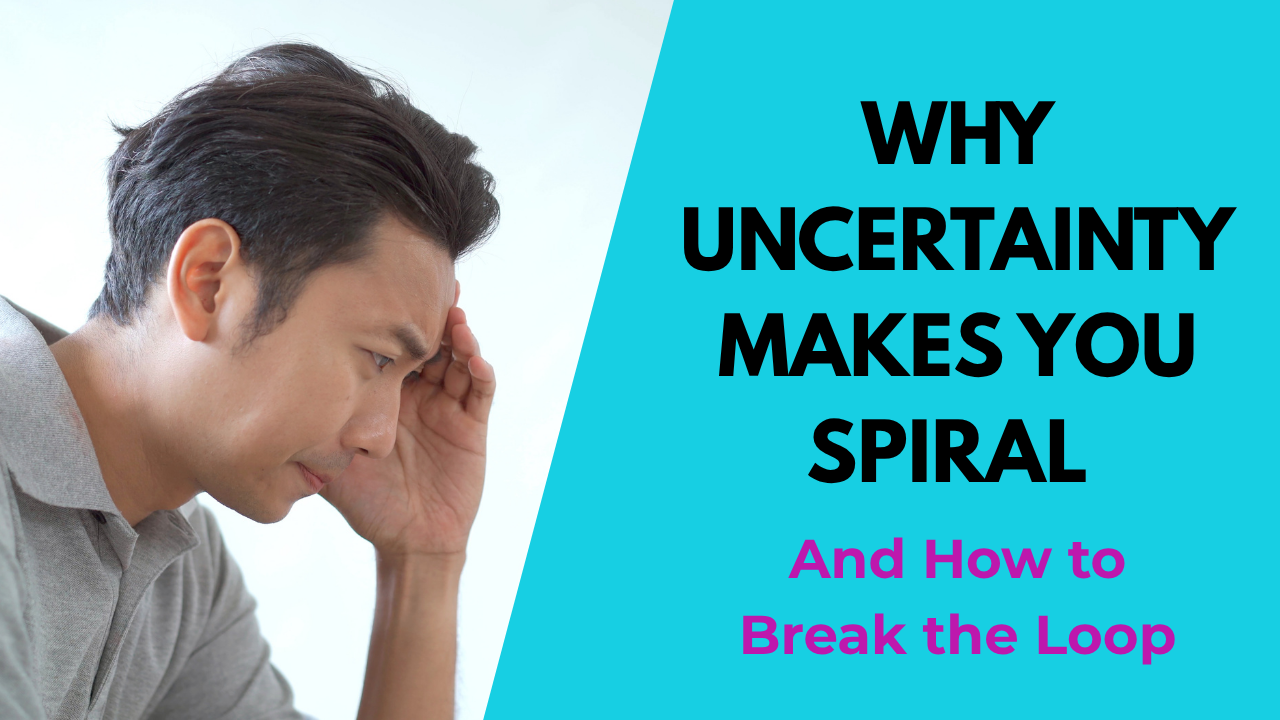
You know the loop.
The one where you're lying in bed at 11:47pm, replaying the same conversation for the fourth time. Or the one where you're in the shower, mentally composing and editing an email you have to send. Or you're "working," except what you're actually doing is running the same worry on a treadmill that never gets you anywhere.
You're ruminating. But did you know that rumination has a biology, a trigger, and a fix?
Rumination Isn't a Character Flaw. It's a Brain State.
Rumination is the repetitive mental loop of dwelling on what's uncertain, what could go wrong, or what already did. And it doesn't show up randomly - it spikes during changes like a new role, shifting team, a bold move you're not sure will land, even growth you wanted.
Change is rumination's favorite breeding ground, because your brain reads uncertainty as a threat to manage, not a situation to sit with.
Three things worth knowing before you try to "think" your way out of it:
- Rumination isn't clarity. It feels productive- like you're working the problem - but you're not. You're spiraling in place while it masquerades as progress.
- It's not a willpower problem. This is your brain trying to keep you safe by refusing to let go of the uncertainty until it's "solved."
- It's trainable. You can move from spiraling to grounded. Not by thinking harder, but by understanding why it's happening and what the brain needs to stop doing it.
How to Stop Ruminating and Looping
Behavioral Activation (BA) is a structured, evidence-based approach that interrupts rumination by giving your brain something to do instead of something more to think about. It's choosing small, specific, meaningful actions (even ones you don't feel like doing) that reconnect you to purpose, pleasure, or progress.
Why it works: Rumination runs on a loop: negative thought → low energy → inactivity → more negative thought. Gah!
Behavioral activation breaks the loop by re-engaging your brain's reward system. A completed action, even a tiny one, triggers a dopamine hit that shifts your internal state.
And the research backs this up: modest, consistent action outperforms "thinking your way out of it" for reducing anxiety and depressive symptoms.
You cannot out-strategize a loop that lives in your nervous system. You have to move through it!
What this looks like in practice: None of it requires a free afternoon or a productivity overhaul:
- Answer the one email you've been avoiding. One task, one reply. Done.
- Block 15 minutes on your calendar for something that actually moves your goals forward, whether or not you're "in the mood."
- Write down one professional goal you're working toward, and just the next step. Not the whole plan. The next step.
- Build a "done list" instead of a to-do list - what you've already accomplished today, in writing.
- Set a 25-minute timer, pick one priority, and work it with zero multitasking.
That's it. That's the intervention. Small, specific, and done - not perfect, not exhaustive.
The Takeaway
The next time you catch yourself circling the same worry for the fifth time, don't ask "How do I think about this differently?" Ask: "What's one small action I can take right now?" Then take it.
Your brain isn't malfunctioning. It's doing exactly what it's built to do during uncertainty. The move isn't to out-think it - it's to give it something real to act on.